
Traceability of our products
SNIM products have been on the market since 1963. Our company ranks second among African iron ore producers with an annual production exceeding 14 million tons.
SNIM controls the entire value chain of its products and offers its customers naturally rich fines (65% Fe), enriched concentrates (66% Fe) and siliceous calibrated (52% Fe). Our commercial products are 100% composed of minerals from our deposits of TO14, Rouessa, Mhaoudatt and Guelbs El-Rhein, located near the town of Zouerate in Mauritania.

QUALITY MANAGEMENT
SNIM is certified to ISO 9001:2015 and aligns all its practices with the requirements of this internationally recognized standard.
The quality management of iron ore products is based on continuous monitoring throughout the entire production chain, from mine to vessel loading. This system relies on quality controls at every stage of the process, including sampling, chemical and mineralogical analyses, stockpile management and reclaiming operations, process optimization, transportation monitoring, and the implementation of corrective actions to ensure full product compliance with customer specifications.
PIT-TO-PORT QUALITY CONTROL PROCESS
SNIM maintains rigorous quality control throughout the entire value chain, from extraction at the mine to shipment at the port.
At the mining stage, blast-hole sampling is conducted to characterize the ore before blasting and transportation to the crushers, enabling precise delineation of mineralized zones. The Company operates five open-pit mines, where ores are classified according to their mineralogical characteristics.
For hematite ores, chemical analyses of iron (Fe) and phosphorus (P) content are used to classify material into three categories: high-grade ore, intermediate-grade ore, and waste rock. This process applies to the TO14, Mhaoudatt, Rouessa, and F’Derick mining operations.
Magnetite ore is mined exclusively at the Guelb Rhein operation.
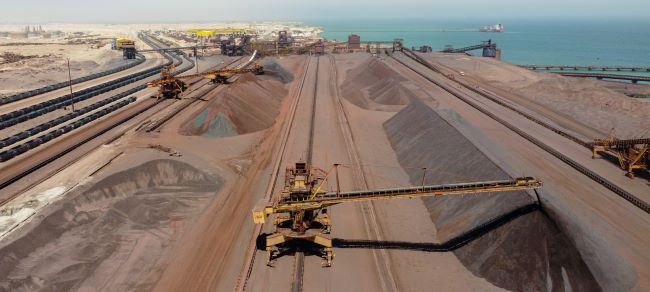
Following crushing and stockpiling, products are closely monitored within plant stockyards and material handling facilities, with each stockpile identified and tracked according to tonnage and quality characteristics.
At the Guelb Rhein processing plants, beneficiation is performed through low-intensity magnetic separation. Concentrate samples are collected hourly to monitor product grade and optimize separator settings, ensuring the best balance between product quality and production volumes.
At TO14, the fines processing plant produces hematite ore with a particle size range of 0 to 10 mm. All production is automatically sampled during both stockpiling and loading operations, and subsequently analyzed in the laboratory.
During train loading, all products are sampled and analyzed. Quality results are transmitted to the port before unloading to facilitate appropriate management of material flows.
Ore transportation between Zouerate and Nouadhibou is organized into production batches designed to ensure cargo homogeneity. Each month is divided into six batches, each representing approximately five days of production and corresponding to a vessel cargo. This approach enables effective synchronization of the various products destined for a single shipment.
Production scheduling is coordinated through a monthly Production and Quality Committee meeting, which establishes transportation plans according to the shipping schedule. Train routing and wagon allocation are then adjusted daily based on operational requirements, stock levels, and arrivals.
This system has significantly enhanced grade control and product consistency, particularly for the strategic commercial product TZFC, which is produced from multiple ore sources.
UNLOADING OPERATIONS AND NOUADHIBOU PROCESSING PLANT
Upon arrival in Nouadhibou, products are stockpiled in designated pre-screening areas according to the quality classification established in Zouerate.
Production from the processing plant is continuously characterized through systematic analyses of finished products, including both fines and calibrated ores.
VESSEL LOADING OPERATIONS
SNIM performs continuous quality monitoring during vessel loading operations.
This control system relies on automatic cross-stream sampling systems, complemented by laboratory analyses conducted at the Nouadhibou laboratory. Assay results are monitored in real time, enabling immediate corrective actions whenever necessary to ensure full compliance with contractual product specifications.
ORE SAMPLING
SNIM has equipped all its production, processing, and material handling facilities with automatic cross-stream samplers to ensure quality monitoring at every stage of the process. These systems comply with the recommendations of ISO 3082:2017, the international standard governing iron ore sampling.
Installed on conveyor transfer points, these devices collect representative samples by intercepting the entire material stream. Sampling frequency and sample mass are determined according to ore variability, lot tonnage, and conveyor throughput.
In 2025, audits were conducted across all sampling stations, including those at Mhaoudatt, TO14, Rouessa, Guelb I, Guelb II, and the port facilities, to verify equipment performance and further strengthen quality assurance processes.
QUALITY INFRASTRUCTURE
SNIM conducts all iron ore characterization analyses within its own laboratory network.
The Chemistry Laboratory serves as the Company's reference laboratory. It performs chemical analyses related to ore characterization from operating mines, production monitoring, shipment samples, and research activities. It also includes a dedicated water quality control unit. Given that the current facility has been in operation since 1967, a new state-of-the-art laboratory has been constructed. Its forthcoming commissioning will further strengthen SNIM’s quality management system and enhance operational excellence in support of customer and partner expectations.
The Mineral Processing Laboratory specializes in testing and characterization of magnetite ores. It is responsible for blast-hole analyses at Guelb Rhein and for characterization studies of deposits under exploration and development.
In addition, several satellite laboratories provide on-site quality control at key operational facilities, including the Guelb plants, the Nouadhibou processing plant, and the Mhaoudatt handling facilities.
QUALITY ASSESSMENT AND PERFORMANCE RATING
All shipments exported by SNIM in 2025 complied with commercial product specifications. The Company’s quality management system ensured full conformity of delivered products while achieving a significant improvement in product consistency.
Compliance rates for the three key quality parameters, iron (Fe), silica (SiO₂), and phosphorus (P), reached 100% across all shipments, demonstrating a high level of process control and quality assurance.
Product quality is assessed through a rating system based on chemical and granulometric analyses conducted at SNIM facilities prior to shipment. The scoring methodology varies according to product type and processing route, including fines (0–10 mm), calibrated ores (10–40 mm), and concentrates (0–1.6 mm).
High-grade and siliceous fines, including TZFC and XFN, are evaluated according to the same rating principles.
2025 QUALITY PERFORMANCE
SNIM’s sustained efforts to ensure the quality of products delivered to customers resulted in an excellent quality score of 9.7 out of 10 in 2025.
CUSTOMER CLAIMS
Customer satisfaction remained at an exceptionally high level throughout 2025, reflected by the complete absence of customer claims during the year.
For more information, please refer to the CSR report
Stakeholders | Governance | Health, safety and wellbeing of our employees | Environment and biodiversity | Contribution to the economic development of Mauritania | Ethics and loyalty of practices | SNIM Foundation | Our certifications